The Long Night of the Grave (1986) by Charles L. Grant
Approaching Charles L. Grant
Readers unfamiliar with The Long Night of the Grave may wish to read my notes only after reading the novel
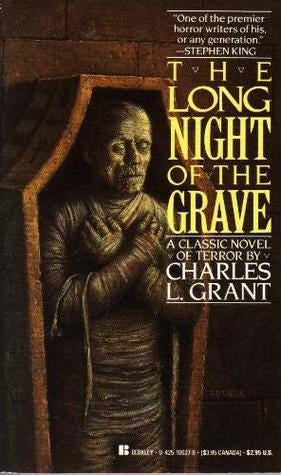
The Long Night of the Grave is the strongest of Grant's "Universal Horror" trilogy. Perhaps this is due to the relative scarcity of mummy novels, even ones that merely transplant the location of 1930s films.
Like The Soft Whisper of the Dead and The Dark Cry of the Moon, The Long Night of the Grave takes place in nineteenth century Oxrun Station, CT. Long Night takes place in the early 1890s, the period of electric cars, electric light, and the World's Columbian Exhibition. Like the previous novels, Long Night deals with an outsider's arrival, the outsider seeking alliance with a powerful local family.
Our hero is John Vicar, a young and modest landowner. While acknowledged as an equal by the local bourgeois grandees, John has ambitious career plans: to own Oxrun's first car dealership.
But Vicar is also one of three men who purchased an Egyptian curio from a since-disappeared archaeologist named Reskin. John Vicar's friend Jeffrey Isle claims desperately that the three curios belonged to him, but he cannot afford to buy them back.
Soon the group who own the three curios find surrendering them to their original owner has become a matter of life and death.
Khirhal Bey thrown from the black gelding just as he reached the cemetery gates. A bolt of lightning just up the street, a charred and smoking branch sparking to the ground, and the horse reared in terror, screaming, eyes white and ears flat. He slid from the saddle before he could grab the mane, and landed in the road, rolled over and covered his head to protect himself from the hooves that lashed blindly out before taking the gelding into the early night.
He groaned softly as he sat up and wiped mud from his face, groaned loudly as he pushed himself unsteadily to his feet. A trembling hand raised as if to call the animal back, then he staggered to the gates and forced them open, slipped through, and held onto the bars until his legs stopped their quaking.
Lightning, and thunder; the headstones flared and vanished, the trees creaked in their twisting, his feet slipped several times, nearly dropping him again.
The rain paused, the wind sighed to a lull, and he broke into a hasty trot, one hand pressed against his side, his eyes narrowed in pain, his lips parted in a grotesque smile.
The mausoleum then, and around the fence to the back where he pulled at the loose bars and tossed them aside, moaning when his arm moved, nearly collapsing when bile flooded his throat and made him turn his head sharply to empty his mouth.
No sound but the dripping of water from the leaves.
No movement until he made his way across the wet grass and sagged against the marble wall, eyes closed, lungs working for a breath; turning when the pain subsided, lifting a hand head high and pressing against the corner of a stained block.
A rumbling.
The wind.
A narrow section of the wall turning inward, revealing a flight of stairs that led deep into the ground.
The rain.
He fell forward against the inner wall, slipped and slid down the steps into the chamber below where he slumped to the floor and covered his face with his hands.
Not now, he ordered to the agony inside; not now, it cannot be, there are things we must do.
Taking slow shallow breaths, then, he stripped off his wet clothes and donned the raiments of the supplicant to the master he served. Then he took the wooden bowl and placed it on the shallow iron plate over the brazier where a single breath brought him flame that he watched for a full minute. He opened the chest next and took out a handful of long narrow leaves, took the figurine’s head off and brought the body to the fire.
He poured the oil.
He watched it heat.
He dropped the leaves in one by one, stepped back, and began to pray.
For an hour he said the words he had learned from the stolen book, the tablet of prayers the heathen Reskin had stolen from his people; for an hour he watched the silent fire, watched the black smoke from the boiling leaves, nearly swooned at the fragrance that began to fill the room in spite of the wind cascading down the stairs.
Then he picked up the bowl. not feeling the burning, and poured the libation drop by drop at the foot of the stone cabinet.
“Sakhtu,” he whispered as each drop boiled on the floor. “Sakhtu, it is time.”
Freddy scrambled on hands and knees into the woods as the fire bellowed through the cottage. Sparks spiraled on the wind, pinpricks on the back of his neck, the backs of his hands, smoldering on the back of his long tattered coat. He didn’t look around, nor did he look side to side; he kept his gaze on the trees that leaned away from him in the storm.
He remembered.
He knew what Mr. Vicar had to be told.
But Gert Naysmith’s house was dying, and he couldn’t stop crying, and finally he dropped to his stomach and wept against the mud, sobbing and moaning and beating the ground with his fists because it was his fault the lightning had found where he was hiding, his fault the monsters were still chasing him in his dreams.
He was frightened.
The house was burning.
And when the storm returned in a great fall of thunder, he· leapt to his feet and began running.
Cab Planter lay on the wooden bench in the station’s front room, his hat for a pillow, his feet crossed at the ankles. He hated staying home on a miserable night like this; there was no one he could complain to, no one he could hold, and those on the night watch were better than nothing.
The telephone rang, and he stared at the empty desk, grunted to his feet and pushed through the gate. When he picked up the receiver and held it to his ear, all he could hear was a faint hissing, like someone whispering from the grave.
“Jesus,” he said to Alden when the sergeant came back into the room, “this is gonna be one hell of a night.”
The doors of the stone cabinet opened without a sound.
Khirhal Bey bowed his head and gave the blackshadow the first of three names.
“There is never,” Howard Turnbell snarled to the empty office, “anyone around when you need them. Jesus, this world is going straight to hell in a handbasket and nobody gives a damn!”
He was standing in his office, coat and hat on, gloves in one hand. A messenger had come to him an hour before, requesting an urgent meeting, there in the bank. Had it been anyone else but Syd Edmunds he would have given the messenger an answer that would have curled the kid’s hair; but for friendship’s sake, he waited, and waited for the hour before his patience grew thin and he turned off the lights.
“The hell with him, “ he muttered as he backed out of the office and locked the door behind him. “The hell with them all.”
Then he dropped the key into his pocket and turned around, and for a moment his ill humor passed as he surveyed his domain — the checkered marble floor, the gleaming marble pillars, the elegant desks, the tellers’ cages, the paintings on the wall and the mural on the ceiling. Lit now only by the glow of a streetlamp outside, the high and wide windows running with rain and running blacksnake shadows across the floor.
A deep breath as if he could smell and taste the money; a satisfied smile and a slow shake of his head.
He would be generous. He would stand here, in his kingdom, and give Syd another chance. But he would not speculate; speculation was for fools like Jeffrey Isle and poor young John. He would wait for five minutes before going home, to the warmth of his fire, his brandy, and the clever chatter of a wife he’d been with forty years.
He smiled.
He adjusted his hat.
He saw the large shadow pass across the window and pause at the doors.
Your five minutes are up, Syd, he thought as he pulled on his gloves.
A shadowarm lifted, and fell against the frame, an echo in the empty room, hollow and loud.
Turnbell started forward, his mood broken, his heels firm. “We’re closed, you idiot,” he called. “Don’t you know the time?”
The shadowarm again, and the heavy frame trembled.
“Damn you,” the banker muttered in disgust, quickening his pace and raising his voice. “Come back tomorrow! We’re closed, damnit, we’re closed!”
And the doors shattered inward, splinters cast by the wind, rain sweeping across the marble.
Turnbell cried out in anger, and cursed because he’d left his walking stick back in the office.
Then he saw it in the doorway.
“My god,” he whispered. “My god, who are you?”
It stepped over the wreckage, sending its shadow out before it, pushing Turnbell back a pace until he spun around with a gasp and ran for his office. There was a special telephone line there, connecting the bank directly to the police station; he would use it, he would be all right, be wouldn’t look around though he heard the footsteps following-slow, and heavy, crushing wood and glass, while the wind tilted with the paintings and cleared the desks of all their papers, and why, he thought in panic, wouldn’t the goddamned key fit?
A fearful glance over his shoulder, and he snapped his head back around, to stare at the keyhole, watch his hands insert the key, watch his fingers slip off, grab hold, slip off and grab again.
The door opened.
A desk was tossed aside, crashing into the wall like the thunder detonating outside.
“No,” the banker gasped as he slammed the door and locked it. “No,” as he ran to the wall phone and lifted the receiver.
The door shuddered.
The wind slipped in underneath.
A crank, then two, then one again, and the door exploded, the blackshadow stepped in.
Turnbell felt his heart racing, felt his legs begin to weaken, and he almost made it to his desk and the gun in the center drawer before the blackshadow’s hand closed around his neck.
He screamed.
He lashed out with his fists and his feet.
He looked into its face, and saw his kingdom explode.
Sgt. Alden stared sullenly at the board on the wall behind him. There were ten rows of red lights, five lights across, and the third one, third row, was blinking in time to a soft chime from a bell mounted above.
“It’s the damned storm,” he said, getting out of his chair to slap the board’s side. “Always happens in a damned storm.”
Planter, once more reclined on the bench, was tempted to agree. He had no wish to go out there tonight, no wish to get soaked to the skin just because some old maid or old man working late in a shop had panicked at a shadow.
Then he sighed and pushed himself up.
Unfortunately. this wasn’t a shop. It was a bank. Worse, it was Howard Turnbell’s bank, and if someone didn’t go over there and have a look around, Stockton when he returned would have Planter’s scalp.
“Hell,” he said, and reached for his coat.
“You going?” Alden asked in surprise.
“Yep. Have to. Get your hat, you need the fresh air.”
“Me?” Alden scowled. “It’s raining out there!”
“Right.”
“Jeez, c’mon, Cab, have a heart.”
“Your coat, Tom,” he said.
“But it’s the storm, I tell you!”
“And if it isn’t? You want to tell Turnbell?”
Alden sighed. “Damn. Planter, you know, you’re a goddamned pain in the ass.”
John listened to the return of the storm and decided he would pass on the dinner tonight. He needed time to think, because he’d done too much thinking already, and every answer he could find always sent him back to the page where he saw the blackshadow, lying in a sarcophagus, arms folded across its chest. And beneath the sketch the. legend that claimed the body belonged to a minor priest who called himself Sakhtu.
On the page the eyes were closed.
He shuddered and went to the phone, and cursed when he heard the dead silence of a dead line. With Karragan gone, there was no way now he’d be able to get in touch with the Avlocks. He would have to go. Indeed, perhaps it would be better that he did. Then he would be able to talk with someone about what he had found, and they in turn would tell him what an ass he was being.
Betty would laugh and show her concern, Syd would bluster and Howard would scoff, and it would be worth it even to hear Jeffrey sneer.
He started to snap off the light, then changed his mind. Instead, he scribbled a note reminding the Karragans of his invitation just in case they should return. All he needed now to complete the day would be Mary carping at him for scaring her half to death, not being home when she stepped in the door. He brought it to the hall and left it on the table, in the center of the silver plate where the calling cards should be.
Say, Betty, he thought, turning toward the stairs, did you know that there’s a dead man walking around Oxrun Station? Syd, old man, I have solved another murder and you won’t believe the killer’s name.
“Johnny,” he told himself as he hurried to his room to dress, “this is crazy. You’re crazy.”
But on the page the eyes were closed.
Grant typically gets mired when his characters begin seeking and doing, though such forward momentum is preferable to the near stasis of his opening paragraphs.
Jay
20 February 2025


